
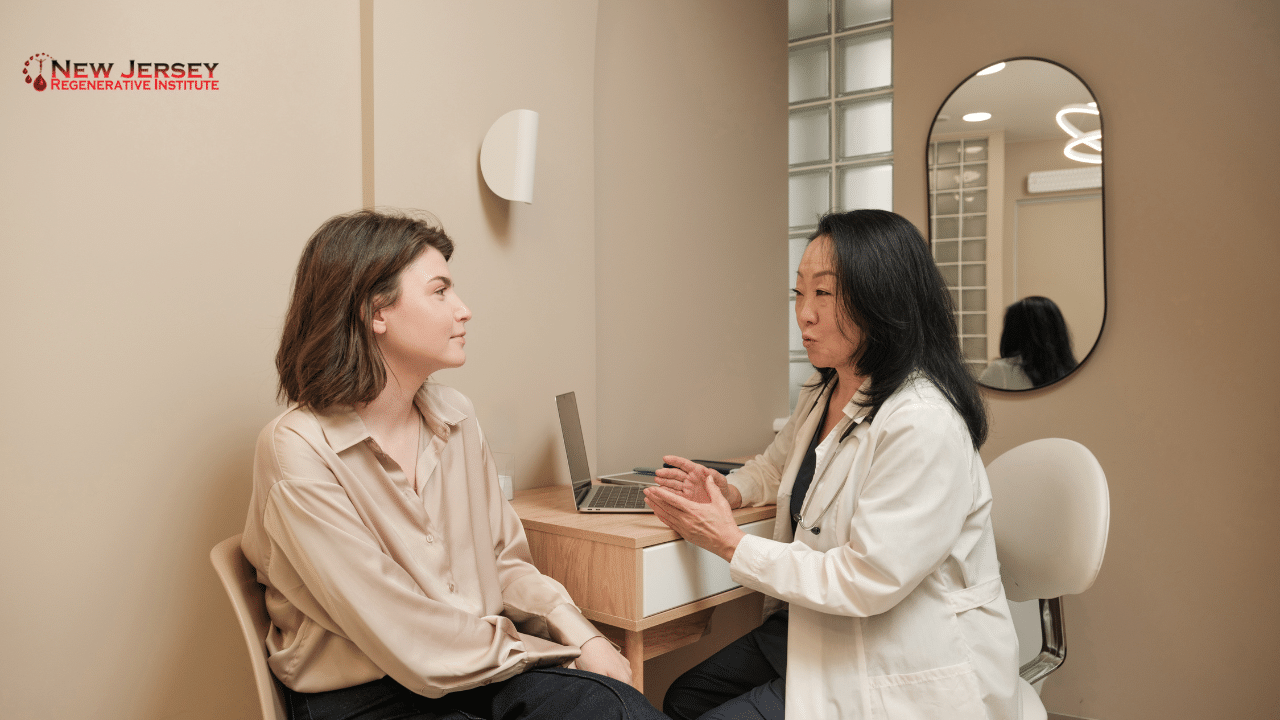
Over the years at New Jersey Regenerative Institute, We’ve had countless conversations with people who are trying to make sense of their options. Many have been in pain for a long time. Some are healing from injuries that never felt quite “finished.” Others are trying to stay active as they age and want to avoid surgery as long as possible.
What they all share is a simple question:
What exactly are regenerative treatments, and how do I know if they’re right for me?
The world of regenerative medicine has grown quickly, and while the science is exciting, it can also feel like a maze. So here’s a straightforward guide—nothing complicated, nothing overpromising, just a clear explanation of what these treatments do, how they work, and when they tend to help.
What Regenerative Treatments Aim to Do
Regenerative medicine focuses on helping the body repair itself more effectively. The body already has a natural repair system. When you injure a tendon or strain a ligament, platelets, growth factors, and specialized cells move in to clean up damaged tissue and rebuild what was injured. The challenge is that with age, overuse, or repeated injury, those repair responses can slow, weaken, or get stuck in a cycle of chronic inflammation. That’s where regenerative treatments come in. They don’t override the body. They support processes that are already there but may need assistance.
This is one of the main reasons people look into regenerative treatment options for chronic pain relief, they want solutions that move toward healing, not just symptom management.
How Do Regenerative Treatments Work?
Different treatments use different tools, but the principle is the same: introducing healing signals directly where the body needs them most.
Here are the most common approaches we use in our clinic:
Platelet-Rich Plasma (PRP)
A small sample of your blood is processed so the platelets and growth factors are concentrated. Those platelets release signals that help repair tissue, calm unproductive inflammation, and support recovery. Research in journals like the American Journal of Sports Medicine shows that PRP can improve pain and mobility in conditions ranging from knee arthritis to chronic tendon injuries.
Prolotherapy
This therapy uses a mild solution that encourages the body to strengthen ligaments and tendons. It’s often helpful for joints that feel unstable or injuries that never fully healed.
Ozone Therapy
Ozone can help modulate inflammation and support oxygen use in tissue. It’s often used as an add-on therapy for people with chronic pain patterns or slow-healing injuries.
Shockwave Therapy
Shockwave uses sound-wave energy to stimulate blood flow and tissue repair. It’s especially helpful for stubborn issues like Achilles problems, plantar fasciitis, and shoulder calcific tendinitis.
This includes biologic materials that support repair at the cellular level. These are used for more advanced injuries or degeneration that needs stronger regenerative support. These are considered advanced regenerative therapies for healing, especially for patients wanting non-surgical options.
The Benefits of Regenerative Treatments
People often look into regenerative therapies because they offer possibilities that traditional care doesn’t always provide.
They work at the source.
Instead of calming the pain for a moment, the goal is to influence the tissue causing the problem.
They are non-surgical.
For many individuals, these are part of a non-surgical regenerative recovery program, which means less downtime and fewer risks.
They support long-term function.
When tissues heal well, movement improves and quality of life tends to improve with it.
They can reduce reliance on medication.
Many patients use fewer anti-inflammatory medications after regenerative care because their underlying issues are being addressed.
When Regenerative Treatments Might Be Right for You
Based on our experience, regenerative therapies tend to help when:
- Pain has lasted longer than expected
- Movement is limited due to soft tissue injury
- There is wear-and-tear arthritis that still has healing potential
- Imaging shows problems that are biologically responsive (tendon degeneration, small ligament injuries, early cartilage wear)
- Standard conservative care helped at first but has plateaued
- Someone prefers to delay or avoid surgery
At our clinic, we commonly treat:
- Meniscus irritation
- Cartilage wear
- Tendinopathy (patellar, quadriceps, hamstring, pes anserine, etc.)
- Ligament sprains (ACL, PCL, collateral ligaments)
- Bursitis
- Bone bruises
- Early arthritis
- Some inflammatory joint issues
A thorough evaluation, often with ultrasound or MRI, helps us determine if regenerative care is appropriate.
The Importance of Diagnosis
This part matters more than anything else. A treatment is only effective when it’s matched to the correct source of pain. A 28-year-old with a meniscus flare-up and a 62-year-old with early cartilage thinning may both have knee pain, but they absolutely do not need the same treatment.
At New Jersey Regenerative Institute, Drs. Agesen and Bowen evaluate:
- mechanics
- stability
- movement patterns
- imaging when needed
- medical history
Once we understand the root cause, we build a plan that fits the condition.
What the Research Shows
Clinical studies continue to grow in this field. Research in Frontiers in Bioengineering and Biotechnology and other journals highlights consistent improvements in function and pain for musculoskeletal conditions treated with regenerative methods. We also track our results through DataBiologics, a national outcomes registry. This lets us compare our patients’ progress to national data and adjust protocols when needed. It also ensures our work contributes to the broader research community.
The Future of Regenerative Care
What excites me most about regenerative medicine is its direction. The science is steadily improving: better preparation methods, stronger biologic materials, more precise imaging guidance, and a deeper understanding of how tissues respond.
But at the end of the day, the philosophy stays the same: support the body so it can do what it’s built to do to heal.
New Jersey Regenerative Institute
299 Cherry Hill Road, Suite 105, Parsippany, NJ 07054
Regenerative Medicine & Non-Surgical Orthopedic Care
Call 973-998-8309 or visit our website to schedule a consultation.
Helping patients heal from the inside out with regenerative solutions tailored to the individual.
Disclaimer: The information provided in this blog is for educational and informational purposes only. It should not be interpreted as medical advice, factual guidance, or intended to be a substitute for professional medical advice, diagnosis, or treatment.